

Why your symptoms alone can’t tell you if you have SIBO
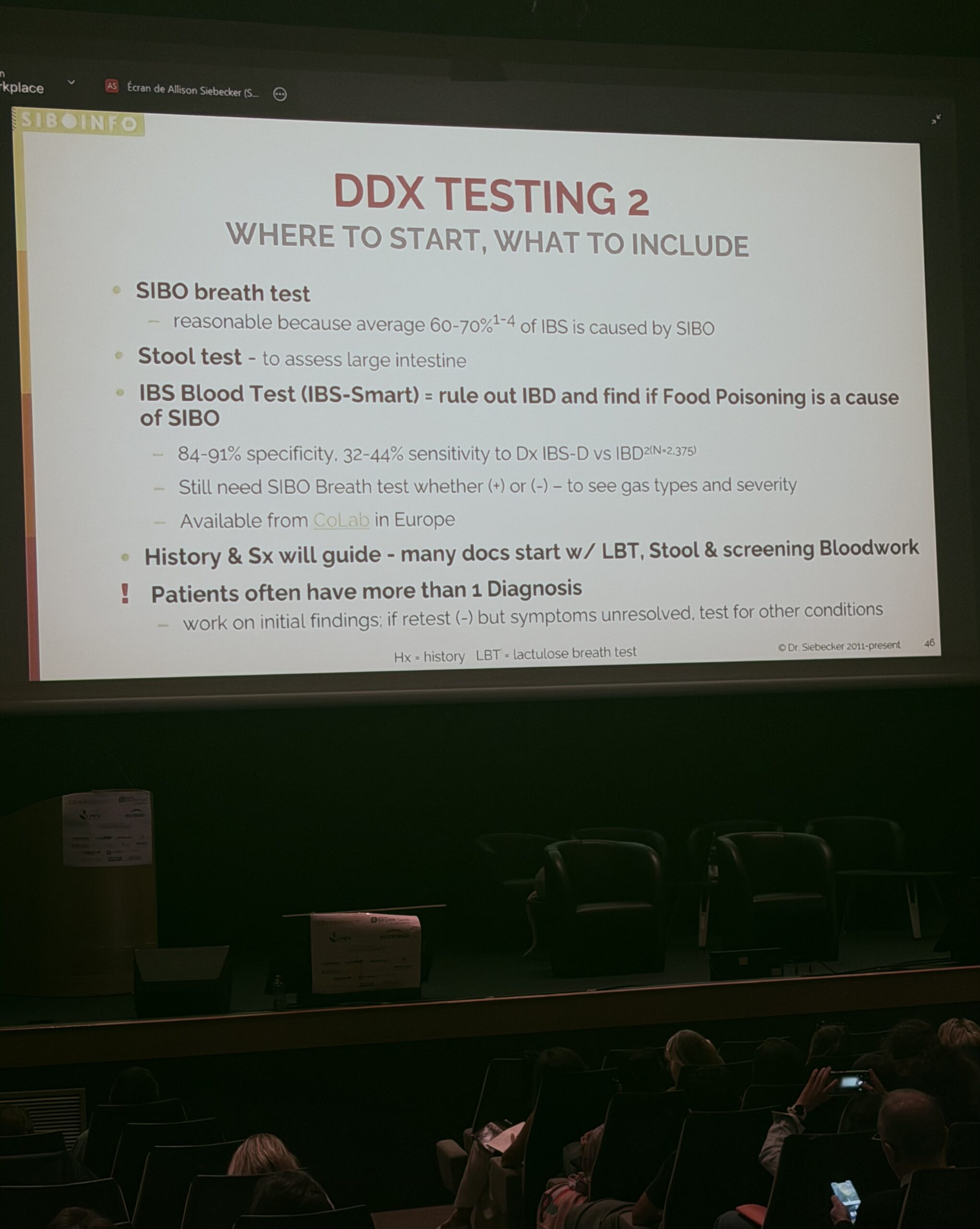
I recently attended the Microbiome 360 2026 conference in Lyon, alongside some of the world’s leading SIBO experts, including Dr Allison Siebecker, Dr Mark Pimentel, Dr Nirala Jacobi and Dr Jason Hawrelak. One slide from Dr Siebecker’s lecture stayed with me because it sums up something we see in clinic every week: you can’t diagnose SIBO from symptoms alone. Testing matters.
Bloating, wind, pain, diarrhoea, constipation, reflux… if you’ve been living with these, you’ve probably typed them into Google and landed on SIBO. It’s an understandable leap, and SIBO is very common in people with IBS. But the research Dr Siebecker presented shows why a symptom checklist isn’t enough.
Dr Siebecker, one of the world’s leading SIBO educators, walked through the evidence. Here are the three points that stood out.
1. Symptoms don’t reveal overgrowth, bacterial or fungal
In a US study, 150 people with unexplained gut symptoms were tested by taking fluid directly from the small intestine and culturing it. Nearly two-thirds had an overgrowth: some bacterial (SIBO), some fungal (SIFO, mostly Candida), and some both. Yet their symptoms looked no different from those of people with no overgrowth at all. The study also found that people who had gut motility problems or took acid-suppressing medication (PPIs) were more likely to have an overgrowth.¹
2. People with and without SIBO have the same complaints
Dr Siebecker presented data on more than 5,000 people with gut symptoms who were breath tested for SIBO. When those who tested positive were compared with those who tested negative, their symptoms were the same: pain, bloating, diarrhoea, constipation, wind, nausea and acid reflux.
3. Bloating has more than one cause
She also shared findings from a smaller group of people with bloating. Those with SIBO had no distinguishing features compared with people whose bloating came from gastroparesis (slow stomach emptying), slow movement through the small intestine, or colonic inertia (a sluggish bowel).
Why this matters for you
If treatment is based on a guess, you might take antibiotics or antimicrobials for SIBO you don’t have, or be treated for bacteria when the problem is fungal, or motility, or something else entirely. That’s often how people end up going round in circles for years, feeling worse and more discouraged.
Testing gives us something solid to work from. A breath test can show whether bacterial overgrowth is present and which gases are involved, and that shapes treatment. It’s just as important to know what a breath test can’t do. It doesn’t detect fungal overgrowth, and it doesn’t rule out motility problems. That’s why results always need to be interpreted alongside your full history by someone who knows this area well.
How we work at IBS & SIBO Clinics
Our practitioners look at the whole picture: your symptoms, history, diet, medications and test results together. Testing doesn’t replace clinical judgement, and symptoms don’t replace testing. You need both.
If you’ve been told “it’s probably SIBO” without any testing, or you’ve been treated and nothing has changed, it may be time to step back and look properly.
book a consultation / order a SIBO breath test OR book the trio smart breath test which includes checking for Hydrogen sulphide
References
¹ Jacobs C, Coss Adame E, Attaluri A, Valestin J, Rao SSC. Dysmotility and proton pump inhibitor use are independent risk factors for small intestinal bacterial and/or fungal overgrowth. Aliment Pharmacol Ther 2013;37(11):1103–11.
Erdogan & Rao 2015, PubMed
Lacy et al. 2021, Rome Foundation
ACG SIBO Guideline 2020 (PDF)
North American Consensus 2017, PMC
